
Last updated on February 24th, 2026 at 02:11 pm

Picking the right aircraft for a transatlantic flight sets the foundation for the entire experience. It’s not just about getting airborne and reaching the destination—it’s about understanding why certain aircraft are designed for long ocean crossings. The aircraft you choose directly affects realism, workload, and how believable the flight feels from start to finish.
When choosing a long-haul aircraft, popular options like the Boeing 747or Airbus A330 make sense because they are designed specifically for extended range operations. Their fuel capacity, systems depth, and long-haul performance profiles align well with the demands of transatlantic routes. Choose aircraft that simulate real-world capabilities in your simulator, offering a range of features that get you the depth you’re looking for in your virtual skies.
Pay attention to performance features like extended range, fuel capacity, and real-world operations in chosen aircraft. The 787 Dreamliner’s fuel efficiency, for instance, makes it an exciting option for enduring long flights while also reducing operational costs in simulation terms. You do want to keep it green, even if it’s virtual!
But it’s not all about size and efficiency. Make sure the aircraft you choose in your simulator environment offers realism in cockpit instruments and operations. It’s also worth paying attention to how accurately the cockpit is modeled. Instrument layout, system behavior, and control responsiveness all play a role in how convincing the experience feels. A well-simulated cockpit encourages proper procedures rather than just flying from point A to point B. Immersive cockpits make you feel like you’re in the belly of the beast, navigating through clouds over the vast sea below!
For those new to flight sims, don’t just go for big names without checking if they suit your setup. Some add-ons demand a lot from your computer’s performance, and you want those smooth takeoffs and landings—you don’t want a slideshow of what could’ve been the epic journey of your sim career!
Navigating Your Skyway: Selecting Realistic Routes and Understanding NATs

Routes between well-known international airports make for more than just sightseeing—they’re essential for getting a real taste of how air corridors work. Think of it as adding a layer of challenge to your flight sim experience. JFK to Heathrow, for example, isn’t just glamorous; it’s busy and requires some real planning chops.
The North Atlantic Tracks (NATs) act as organized routing systems across the Atlantic, adjusted daily based on jet stream winds, traffic flow, and operational efficiency. Because they change frequently, they add an extra layer of realism and planning to any transatlantic simulation. These aren’t permanent fixtures in the sky—they change. With the NAT system, you’re not just following a pre-laid track; you’re interacting with a dynamic environment that reflects real-world air traffic management needs.
Understanding NATs really brings a level of sophistication to your simming experience. They’re chosen for optimal efficiency—balancing fuel consumption, flight time, and safety. Following these tracks gives you a taste of how pilots make real-time decisions based on shifting high-altitude winds and other factors.
Planning tools such as SimBrief help replicate real-world dispatching by generating accurate routes, fuel calculations, and performance data. Using these tools adds structure to long-haul flights and reduces guesswork during planning and cruise.
When choosing routes, consider the time of day and season as well. Even simulated winter storms can make for a bumpy ride, adding variety to the flights and improving your piloting skills in a virtual cockpit. This will certainly make those smooth landing moments much more satisfying!
Preparation and Precision: Effective Flight Planning and Oceanic Navigation
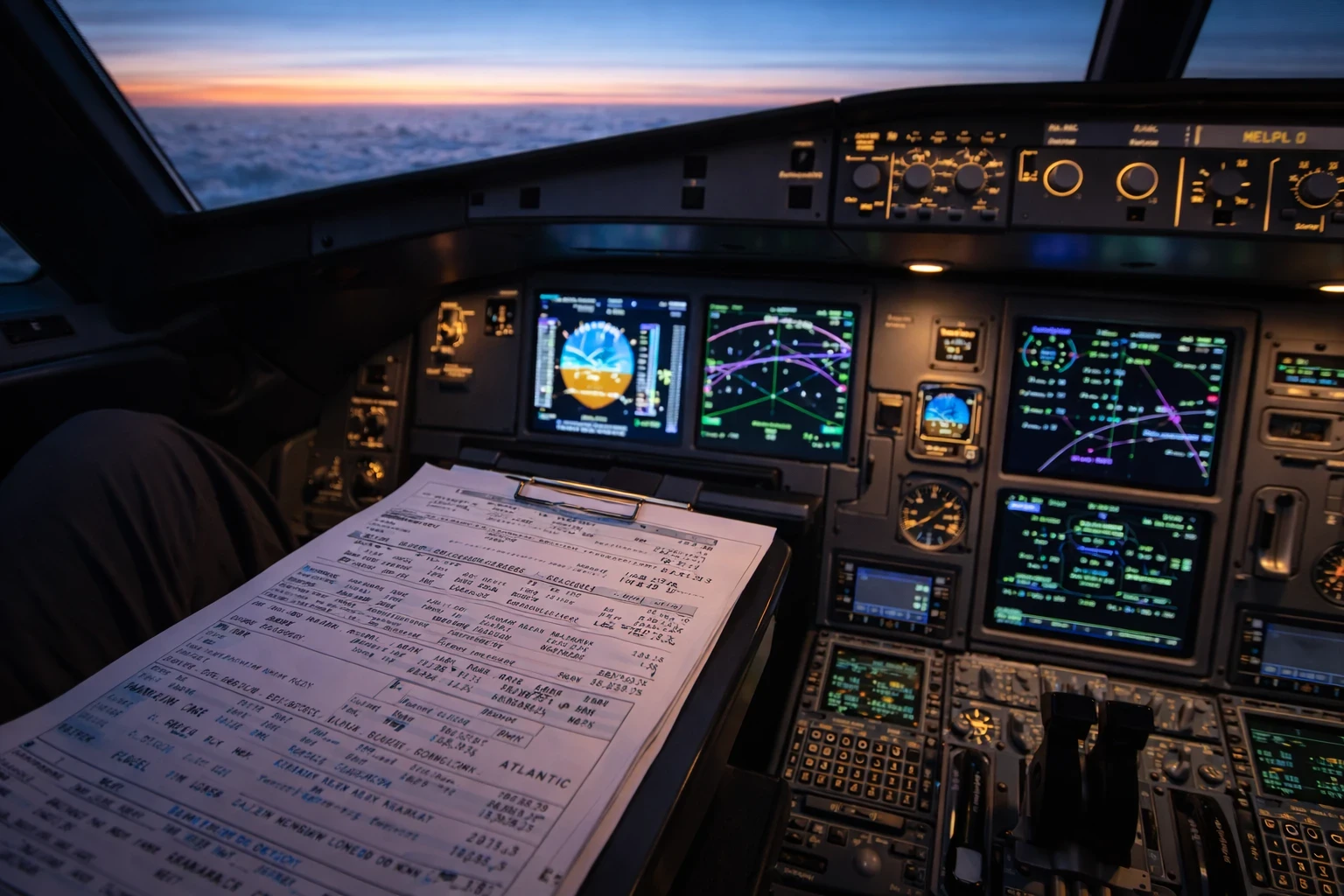
Getting flight planning right is like packing for a journey across the ocean—you don’t want to realize halfway there that you’ve left something crucial behind. When it comes to simulating a flight across the Atlantic, the importance of solid preparation shines through.
Fuel planning is a major part of your pre-flight checklist. You need to understand your aircraft’s fuel consumption rates and adjust them for the weight of passengers, cargo, and the expected wind conditions of your route. Keeping tabs on this allows you to manage emergencies like unexpected detours, keeping the realism factor high.
Alternate airports are another cog in your planning machine. These are your safety nets, ready if bad weather or mechanical issues push you off your charted course. Knowing alternative airports’ locations en route gives your flight sim experience a robust layer of strategy and preparedness.
Flight plans for transatlantic flights come packed with jargon that might seem like another language, but decoding this reveals the realism hidden within. From climb speeds to altitude restrictions, these elements add another layer of authenticity. Tools are handy here, providing you with professional-grade flight plans with a click or two.
Navigating the open waters of the Atlantic adds an exciting twist to your flight. Without the usual land-based navigation aids, you’re relying on modern navigation systems. This is where skills with things like inertial navigation systems (INS) are put to the test, ensuring you’re on track and every degree counts!
Embracing Nature’s Whims: Weather, Winds, and the Wonders of the Atlantic

Taking on the Atlantic isn’t just about close encounters with cockpits and navigation charts. Real-time weather simulation can transform a straightforward transatlantic flight into an adventure.
Emulating live weather conditions keeps you on your toes, introducing an unpredictable element that demands adaptation. You’re not just coasting through clear skies; sudden turbulence or rapidly changing visibility can make your flight an unpredictable ride.
Look into the jet streams, those high-altitude currents that planes hitch a ride on to save fuel and time. Understanding wind patterns is crucial, and exploiting these can shave off precious minutes from your journey, just like in the real aviation world.
Different seasons bring their flavors to transatlantic crossings. Summer flights might encounter fewer turbulence patches compared to the turbulent winter months, while the shift of day to night across time zones paints new challenges and atmospheres.
Dealing with unexpected storms is part of the gig, forcing quick decision-making and skillful adjustments. Learning to handle turbulence and avoid the eye of a storm adds more depth to your sim pilot skills. After all, smooth air won’t make you better!
Executing a Seamless Transition: From Ground to Sky to Taxi
Kicking off your flight isn’t just about the actual flying. It’s about the whole shebang, from bringing your virtual plane to life to shutting it down after a successful journey across the pond. For those looking to strike gold in realism, treat this as a full airline operation.
Online ATC networks come into play here, adding a social dimension to your flight sim. They simulate air traffic communication, challenging you to stick to real-world procedures. Platforms like VATSIM or IVAO offer dynamic communication with virtual controllers who keep the airwaves buzzing just like reality.
Mastering startup procedures brings an authentic touch to your simulation—each checklist item is a step toward achieving that real pilot feel. Taxiing out, lining up on the runway, and making the climb to cruising altitude echo the busy hustle of a real airport environment.
Long cruise phases call for some form of time acceleration—while still keeping you alert. But don’t rush it all the time; maintaining focus during the monotony of long flights ensures you’re prepared for any sudden changes, like weather or traffic adjustments. This lets you practice resourcefulness and patience of experienced long-haul pilots.
Finally, landing isn’t just about getting wheels on tarmac. Embrace the full experience by simulating the post-landing routine: taxiing to the gate, handling shutdown procedures, and even debriefing. In the end, realism in a transatlantic flight isn’t limited to the time spent in the air. It’s the combination of planning, execution, and follow-through that makes the entire experience feel complete.
Where Preparation Turns Into Immersion
Long-haul flying rewards patience and attention to detail. Careful planning, realistic routing, and adapting to changing conditions transform the simulator into something far more engaging than a simple point-to-point flight. Over time, these crossings sharpen skills that shorter routes rarely touch.
If you want to explore more long-distance flying ideas and structured routes, you can build on this approach by looking at iconic aviation routes flown around the world, which naturally extend the same planning and realism mindset.